
Are You the Weakest Link?
Understanding and Mitigating Supply Chain Risk in the Defense Industrial Base

OverviewExecutive Summary
Supply chain risk in the Defense Industrial Base is broad, multi-dimensional, and unavoidable. It is also not primarily a cybersecurity problem. Cyber is one thread among many that includes financial fragility, foreign dependency, regulatory complexity, and structural concentration.
Non-compliance is not a paperwork gap. Contracts can be disqualified, deliveries halted, and a single breach anywhere in a supply chain can cascade in both directions. The government is tightening third-party assessment requirements. Primes are holding supply chains accountable. The window to get ahead of this is narrowing.
This paper identifies the ten most common supply chain challenges in the DIB, clarifies what DFARS and CMMC actually require, and lays out the mitigations that matter most: risk scoring, diversification, supply chain illumination, and continuous monitoring.
Section 1The Stakes

Every defense contractor sits inside a supply chain. Consider the F-35. Lockheed Martin is the prime contractor, but more than 5,000 companies sit within the broader F-35 supply chain. Tier 1 subcontractors include Northrop Grumman, BAE Systems, and RTX. Below BAE Systems sits L3 at Tier 2; below L3 sit its suppliers at Tier 3, including Pratt & Whitney; below Pratt & Whitney sit suppliers such as Woodward at Tier 4 and 5. The chain extends much further still. A weak link anywhere along this chain can degrade the security, schedule, or integrity of the overall program.
Risk runs in both directions: the risk a contractor poses to its customers, and the risk its own supply base poses in return. Whether you are a $5M machine shop or a Tier 1 systems integrator, you serve customers above you in the chain. You are obligated to deliver to specification, on schedule, and in compliance with the cybersecurity and regulatory requirements your customers flow down to you. The risk you represent to your customers is real, and it is increasingly being measured.
At the same time, every contractor depends on its own suppliers, who depend on theirs, and so on. A breach, financial collapse, or production failure several tiers below your own walls can disqualify your bid, halt a delivery, or expose your most sensitive data. Supply chain risk must therefore be evaluated from two perspectives at once: the risk you represent to your customers, and the risk your suppliers and their suppliers represent to you.
Small sub-tier suppliers rarely have the resources, expertise, or budget of the large primes. One might expect Lockheed, BAE, or RTX to invest in helping their smaller suppliers reach an adequate security baseline. In practice, most do not. Liability concerns mean primes typically avoid prescribing specific security measures to smaller suppliers. The most vulnerable links are left to navigate compliance alone.
“Small, non-traditional contractors are the most vulnerable link in the defense supply chain – the ‘soft underbelly.’”
– Ellen Lord, former Under Secretary of Defense for Acquisition and Sustainment
Section 2Risk Is Multi-Dimensional

Supply chain risk cannot be reduced to cybersecurity. A supplier that scores well on cyber can still represent serious risk across other dimensions. Decisions and conversations about suppliers must therefore be evaluated across the full set of dimensions, not just one.
- Cyber: Unpatched systems or compromised accounts anywhere in a supply chain are potential entry points. Smaller suppliers are disproportionately targeted and often hold sensitive data they do not recognize as such. A low-security supplier with network access to a higher-security prime is a lateral movement vector.
- Compliance: If a critical supplier fails its CMMC assessment, the delivery chain above it may be disqualified. Flow-down responsibility means contractors are accountable for their supply chain’s compliance, not only their own.
- Financial: Suppliers on thin margins can fail without warning. A missed delivery is usually the first visible signal, not a bankruptcy notice. Single-source dependencies amplify this risk significantly.
- Operational: The prime contractor base has shrunk from 51 companies in 1990 to 5 dominant primes today. Consolidation converts distributed risk into correlated, systemic risk: when one large node fails, every program it touches is affected.
- Geopolitical: Approximately 85% of rare earth processing is in China. Semiconductor fabrication is concentrated in Taiwan. These dependencies cannot be unwound quickly. A foreign acquisition can change the risk profile of a long-standing supplier with no visible warning.
- Concentration: Widely used commercial software creates horizontal single points of failure across the ecosystem. The SolarWinds compromise demonstrated the scale. Similar exposures exist across the DIB today.
Real-world examples are not theoretical. Foreign acquisitions have placed Chinese-controlled robotic arms inside U.S. defense assembly lines. Submarine shipbuilders dependent on titanium castings continue to source from foreign suppliers. Each of these is a separate dimension of the same supply chain risk. These risks also interact. Consolidation reduces visibility. Poor data integration prevents compliance. Regulatory complexity drives smaller suppliers out of the DIB. Attrition concentrates risk on those who remain. No single intervention resolves the system.
Section 3The Top Ten Most Common Challenges

DIB contractors – and especially small contractors – face a remarkably consistent set of supply chain challenges. The following ten, presented in descending order, capture what we see most often. Their ranking depends on the contractor’s tier and industry; many practitioners would argue that any of these could be number one for them.
Visibility Ends at Tier 2
Reliable visibility extends only one to two tiers deep. Flow-down clauses weaken as contracts become purchase orders. Vendors protect positions by not disclosing sub-suppliers. Counterfeit components, foreign ownership, and compromised software enter supply chains at Tier 3 and below – precisely where oversight is absent.
Dependency on Foreign, Fragile, and Adversarial Sources
U.S. defense relies on foreign and adversarial sources for aviation components, lithium batteries, critical minerals, and submarine-grade titanium. Chinese-manufactured equipment has been traced on active defense assembly lines. These are structural dependencies, not edge cases.
Uneven Cybersecurity Across the Supplier Base
Large primes have dedicated security teams. Most of the 300,000+ small businesses in the DIB have one IT person. Systems range from modern cloud infrastructure to unpatched operational technology decades old. Geographic and jurisdictional variation compounds the picture. The weakest supplier with network access to a sensitive environment is the attack surface.
Fragile Suppliers Who Will Not Signal Distress
Many heavily relied-on suppliers are small businesses with limited appetite for compliance investment. Resistance is common: “If I have to implement that, I’ll close my doors.” The prime finds out there is a problem at missed delivery or audit failure – not before.
Overlapping Regulatory Requirements
Contractors operate simultaneously under DFARS 252.204-7012, CMMC 2.0, NIST 800-171 and 172, ITAR, EAR, Section 889, Section 5949, and GDPR where applicable. Compliance with one is not compliance with the others. Multiple CMMC revisions have forced repeated re-investment. The cascade of new requirements from prime to Tier 2 and 3 takes months to years.
Long Lead Times and Production Bottlenecks
Lead-time issues show up in two places. First, on the readiness side: even a high-quality self-assessment or third-party CMMC certification is a 12-to-18-month process for an unprepared organization. Second, on the production side: small and mid-sized manufacturers are often locked into vendor-approved lists. They cannot ship until every approved supplier delivers, and they cannot substitute outside the list. The result is a brittle production system in which a single approved supplier’s slip can cascade through a program.
Poor Data Integration Across the Ecosystem
SPRS scores, assessment evidence, POA&Ms, and audit logs typically sit in separate systems. Without integrated data, SPRS scores reflect belief rather than verified posture. Configuration drift and scope changes move organizations out of compliance between assessments with no visible signal. Primes face the same problem with their supply chains – questionnaires and point-in-time audits are stale the day they are completed.
Demand Surges Expose Capacity Gaps
New programs create sudden demand for suppliers who are already stretched. Vendor-approved lists become capacity bottlenecks. Qualifying a new supplier cannot be done under pressure – it requires proactive investment before the surge arrives.
Supplier Consolidation and Single Points of Failure
Every program that depends on one supplier for a critical component has a single point of failure. Merged systems resulting from acquisitions or adding new systems to a previously CMMC Level 2 Certified environment can trigger a significant change requiring recertification. Consolidated suppliers with shared IT infrastructure enable lateral movement from one business unit to another. Fewer, larger suppliers means a single breach affects more programs simultaneously.
Technology Transition Challenges
Technology transition is reshaping the DIB on several fronts at once. Contractors are migrating from commercial cloud to government cloud, replacing security stacks, and rethinking physical security alongside digital. Many small contractors have cycled through multiple MSPs after being sold compliance solutions that could not be delivered. NIST 800-171 Rev. 3 brings real improvements but a meaningful uplift in obligations. Mid-migration organizations may currently be less compliant than before they started.
Section 4Regulatory Obligations

Members of the DIB have explicit responsibilities tied to the type of data they handle. Those responsibilities will increase as CMMC transitions from NIST SP 800-171 Rev. 2 to Rev. 3. The starting point is understanding what flows down, to whom, and on what terms.
Flow-Down Requirements Under DFARS 252.204-7012
DFARS 252.204-7012 requires prime contractors and subcontractors to include the clause, in its entirety, in all related subcontracts without alteration except to identify the parties. The clause states explicitly:
“The Contractor shall include this clause, including this paragraph (m), in subcontracts, or similar contractual instruments, for operationally critical support, or for which subcontract performance will involve covered defense information, including subcontracts for commercial products or commercial services, without alteration, except to identify the parties. The Contractor shall determine if the information required for subcontractor performance retains its identity as covered defense information and will require protection under this clause, and, if necessary, consult with the Contracting Officer.”
This is a continuous obligation – it applies every time a new subcontractor is brought on, and requires ongoing verification that subcontractors remain compliant at six months, one year, and two years into a contract. Most non-compliant contractors have subcontractors handling CUI who have never seen the clause.
CMMC Levels
Requirements vary by data type and CMMC level:
- Level 1 (FCI): 15 basic controls from FAR 52.204-21. Annual self-assessment and affirmation. Applies to any contractor handling federal contract information.
- Level 2 (CUI): 110 controls from NIST 800-171 Rev 2. Third-party or self-assessment as determined by the contracting officer. Contracts involving Controlled Technical Information, Critical Infrastructure Security Information, or Naval Nuclear Propulsion Information should expect third-party assessment requirements.
- Level 3 (High-Sensitivity CUI): 24 additional controls. C3PAO assessment followed by government DIBCAC certification.
ESG as a Dimension of Supplier Risk
Primes are increasingly evaluating their supply chains through the lens of Environment, Social, and Governance (ESG) standards. ESG evaluates how responsibly a company operates and its long-term sustainability – exactly the question raised by the recent abrupt closure of an MSP serving several companies in the DIB.
Three categories define ESG:
- Environmental: climate impact and carbon emissions, energy use and resource management, waste, pollution, and broader environmental stewardship.
- Social: employee treatment, safety, and diversity; human rights and labor practices; community impact and customer protection.
- Governance: board structure and oversight; business ethics and anti-corruption controls; transparency, accountability, and executive compensation.
For smaller contractors, ESG can appear to be a large-enterprise concern. It is becoming an increasingly important dimension of risk for the larger corporations that buy from them, and small contractors should expect ESG questions to appear more frequently in vendor assessments, RFIs, and RFP
Other Responsibilities
Beyond CMMC, contractors should treat the full regulatory stack as part of their responsibility set: ITAR, EAR, Section 889, Section 5949, GDPR (for any EU-touching operations), ESG expectations from increasingly demanding primes, and industry-specific frameworks. Compliance with one is not compliance with the others, and the cost of treating any of them as an afterthought is increasingly high.
Section 5Risk Mitigations That Matter
There are concrete steps DIB contractors can take to mitigate supply chain risk or, at minimum, to limit its potential impact. Three mitigations stand out:
Risk Scoring
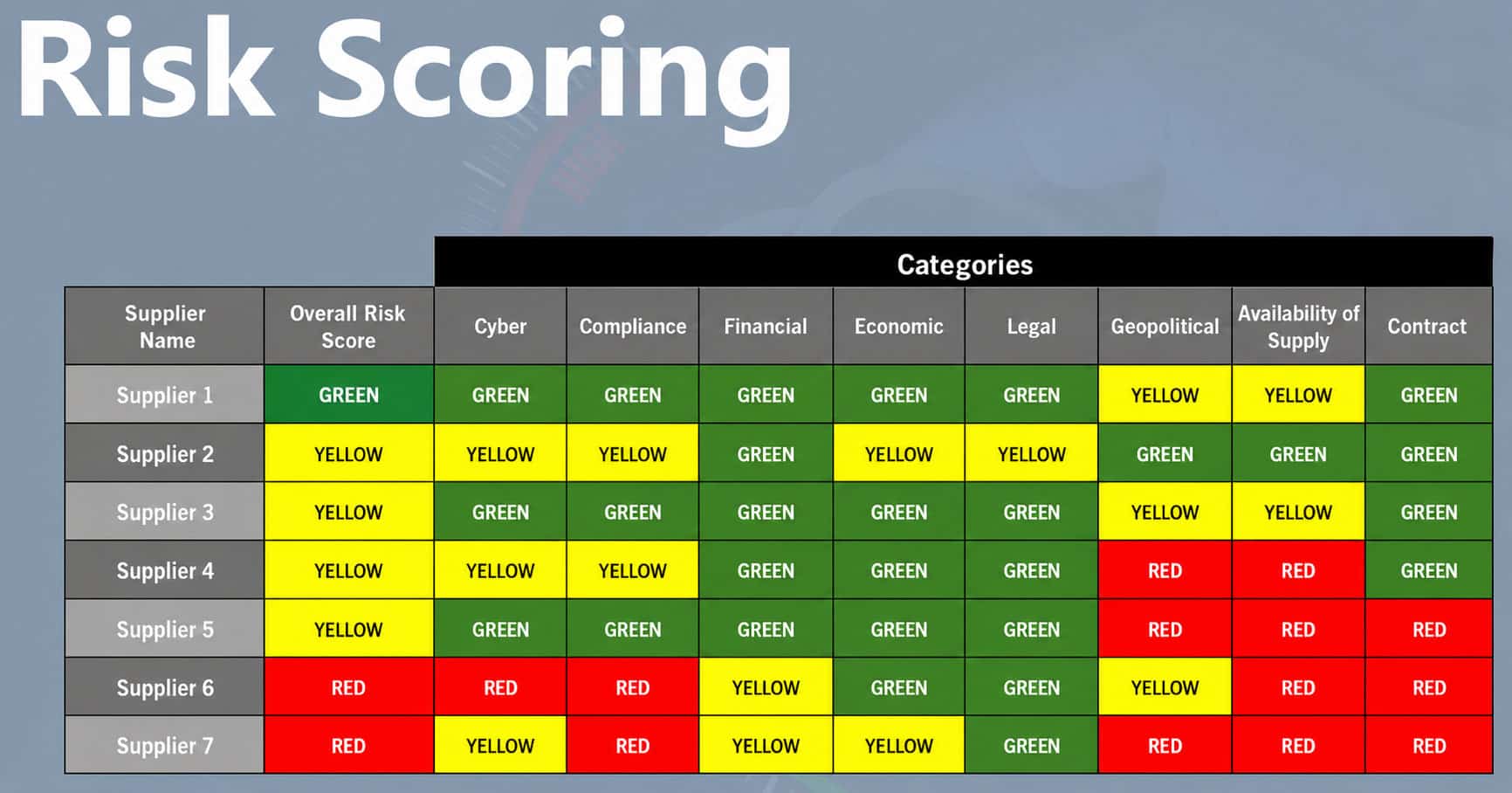
Prioritization is the starting point. For each risk, assess likelihood and impact. Concentrate resources on high-likelihood, high-impact items first. A heat map is the typical visualization: high likelihood and high impact in the upper right (red); low likelihood and low impact in the lower left (green). Resources concentrate on the red, then on the orange, with the goal of bringing items into yellow and green over time.
The critical reminder: risk is multi-dimensional. A supplier may score “green” on cyber while presenting serious geopolitical, financial, or concentration risk. Risk scoring must reach across all dimensions, and supplier conversations must address all of them.
Diversification and Resilience
Resilience is the ability of a supply chain to anticipate, withstand, adapt to, and recover from disruptions while continuing to deliver required products or services. It requires visibility, diversified suppliers, contingency planning, and flexible operations so that failures at one point in the network do not halt the entire system.
Single-source dependencies are among the highest-risk items on most supply chain matrices and among the hardest to fix under pressure. Qualifying an alternative source takes months. This work must happen before a disruption, not during one.
- Map every single-source dependency for critical components.
- Qualify at least one alternative source for the highest-risk dependencies.
- Build contingency plans for the most fragile supplier relationships before they are needed.
Supply Chain Illumination
Most contractors have reasonable visibility into Tier 1. Almost none have reliable visibility below that – which is where the most dangerous risks tend to sit. Supply chain illumination addresses this directly
The challenges outlined above share a common thread: most of the risk in a defense supply chain is invisible until it becomes a problem. Compliance posture degrades between assessments. Suppliers experience financial or operational distress without signaling it upstream. Cybersecurity gaps persist at Tier 3 and below precisely because no systematic mechanism exists to surface them. Point-in-time audits and annual questionnaires were designed for a slower, more stable environment – not for a supply base of thousands of small businesses operating under overlapping regulatory frameworks, facing demand surges, and managing technology transitions simultaneously.
FutureFeed’s CyberIllumination™ was developed to address the visibility gap that sits at the center of several of these challenges. Rather than relying on periodic self-reporting or manual outreach to subcontractors, the platform provides prime contractors with a continuously updated picture of their supply chain’s CMMC and NIST 800-171 compliance posture across multiple tiers. Compliance status, SPRS scores, assessment evidence, and control implementation data are aggregated into a single view, replacing the fragmented picture that results when that information lives in separate systems – or exists only as a questionnaire response from six months ago.
For compliance and program teams managing the challenges described in items ten, eight, and four – limited tier visibility, uneven cybersecurity across the supplier base, and poor data integration – this means that configuration drift, control gaps, and assessment currency are visible as they develop rather than discovered at audit. For contracts and business development teams navigating the regulatory complexity described in item six, it means that the compliance representations made in proposals and program reviews rest on current, documented evidence rather than assumed status. For supply chain organizations contending with fragile suppliers and consolidation risk, described in items seven and two, early signals of compliance degradation provide an opportunity to intervene before a missed delivery or program disruption forces the issue.
CyberIllumination™ does not resolve the structural dependencies, lead-time constraints, or technology transition challenges that characterize the current DIB environment. Those are problems requiring investment, policy, and coordination across the industrial base over years. What it does provide is the foundational visibility that makes active supply chain risk management possible – converting compliance posture from a periodic snapshot into an operational data stream that program, contracts, and security teams can act on in real time.
Section 6The Need for Continuous Monitoring

Compliance is not a project with an end date. In any given quarter: suppliers gain and lose certifications; ownership changes shift geopolitical risk; financial conditions change; infrastructure migrations introduce new gaps. Earlier this year, an MSP serving multiple DIB contractors closed abruptly, leaving its customers non-compliant with their shared responsibility agreements overnight.
Continuous monitoring means three things in practice:
- Supplier scores and POA&Ms are living documents, updated as environments change – not refreshed once per assessment cycle.
- Illumination tools surface changes in compliance posture in real time.
- Supplier risk reviews are cadenced – quarterly minimum for critical suppliers, with immediate triggers for ownership changes, financial stress, or scope changes.
The five core risk domains – visibility, cybersecurity variance, compliance complexity, data fragmentation, and consolidation – are interconnected. No single actor has the incentive or leverage to resolve the system unilaterally. Sustained investment, government mandate, and visibility deep enough to see problems before they become crises are all required.
Section 7Priority Actions
| Action | Why It Cannot Wait |
|---|---|
| Conduct a realistic gap assessment | Plans built on assumed posture fail assessments. Start with what is actually true. |
| Locate all CUI in the environment | Many assessments fail because CUI scope was never established. This is the prerequisite for everything else. |
| Flow DFARS down to subcontractors | If this has not been done, the contract is already in breach. It also surfaces which suppliers represent the most urgent risk. |
| Score and prioritize suppliers | Not every supplier can be addressed at once. A risk matrix focuses effort where it matters most. |
| Build visibility below Tier 1 | Customers are beginning to require evidence of sub-tier compliance posture. Being ahead of that requirement is a competitive advantage. |
| Start the certification timeline now | 12 to 18 months to Level 2 certification. There is no shortcut. |
| Treat monitoring as operational | Certification does not hold without ongoing processes to maintain posture between assessments. |
Section 8Summary and Key Takeaways
Supply chain risk in the Defense Industrial Base is broad, multi-dimensional, and unavoidable. Contractors who treat it as a one-time CMMC exercise will be exposed; contractors who treat it as ongoing operational discipline will compete and win.
Your customers, whether the government, a prime, or subcontractor, are evaluating the risk you pose. Some key points to remember:
- Reliability reduces program risk. Deliver consistently and on schedule, and your customers will treat you as the strong link in their chain.
- Illumination matters. Build real-time visibility into the suppliers and sub-tier suppliers in your supply chain and understand where vulnerabilities sit.
- Security and compliance go together. Use CMMC and adjacent frameworks to genuinely raise your security posture, not just to clear a checkbox.
- Diversify. Avoid critical single-source dependencies wherever the business model allows.
- Be resilient. Build the ability to recover quickly from disruption – natural, financial, geopolitical, or cyber.
- Comply broadly. CMMC is necessary but not sufficient. ITAR, EAR, Section 889, Section 5949, , and ESG all sit in the same regulatory frame.
- Monitor continuously. Risk scoring, illumination, and supplier reviews are living processes, not annual events.
The companies that internalize these principles will reduce their own risk and the risk they pose to their customers.
About This Paper
This white paper is based on the FutureFeed Explorers webinar “Supply Chain Risk: Are You the Weakest Link?” delivered on May 20, 2026, featuring Stuart Itkin, Amy Williams, and Joy Beland (Summit 7). It reflects the perspectives shared in that session and is offered for educational purposes. For inquiries about CyberIllumination™ or other topics raised in this paper, contact the FutureFeed team.

