
Your Holistic CMMC Journey Incorporating FutureFeed

by Amy Williams
Vice-President of Compliance and Education
This onboarding framework walks FutureFeed users step-by-step through building a complete, sustainable, and assessment-ready CMMC compliance program. Each step aligns with how FutureFeed organizes data, workflows, and reporting so that you can confidently manage your entire compliance lifecycle in one platform.
Step 1 – Identify Where CUI Lives
Begin by documenting where Controlled Unclassified Information (CUI) enters, flows through, and resides in your organization. In FutureFeed, this starts within the Contract module, where users capture CUI-triggering clauses and associated workflows.
Example:
A new DoD contract indicates CUI will be exchanged through a secure email.
Step 2 – Scope Your Compliance Environment
In the Assets module, classify all systems that interact with or support CUI, including:
✅CUI Assets
✅Security Protection Assets (SPAs)
✅Contractually Required Managed Assets (CRMAs)
✅Specialized Assets (SAs)
✅Out-of-scope Assets
In FutureFeed, you can upload your data flow diagram that maps how files are downloaded to a project directory, and note which teams interact with the information as a starting point for building out your compliance program. Your DFD should include designations for each of the above asset types. FutureFeed provides structured fields and workflows to keep these designations consistent.
Step 3 – Define and Optimize Boundaries
Designate a compliance leader with the authority to drive organizational change. FutureFeed allows you to capture roles and link it to responsibilities, evidence approval, and workflows. Finding the perfect person to lead compliance is challenging because they need to know a bit about cyber security, a bit about project management, and they need to have authority in the organization to assign tasks to people.
Generally speaking, completely outsourcing CMMC preparations is not very often successful because of the fact that people within the organization need to comply and third parties don’t have the authority to make that happen generally speaking. Hiring a third-party advisor to help you get organized, collect and manage data and identify key steps to success is a completely different thing which is incredibly valuable for most organizations.
At the end of the day there will be steps your internal team needs to take, however, and that’s where the internal advocate comes in. Educating at least one employee by sending them through CMMC CCP training has proven to be an excellent investment for a lot of companies.
Example:
Leadership assigns the Compliance Lead, sends them through CMMC CCP training and then designates them as the admin for the subscription to FutureFeed as the approver for managing additional users, ensuring all appropriate documents are uploaded and that remediation tasks are assigned and completed.
Step 4 – Empower Your Internal Authority
Assign control owners and document supporting tools within FutureFeed’s Controls and Assignments features. Establish who will track updates, evidence, and ongoing compliance.
Example:
You assign IT Security to manage logging controls, HR to maintain personnel screening evidence, and configure automated reminders within FutureFeed to enforce accountability.
Step 5 – Identify Tools, Methods & Stakeholders
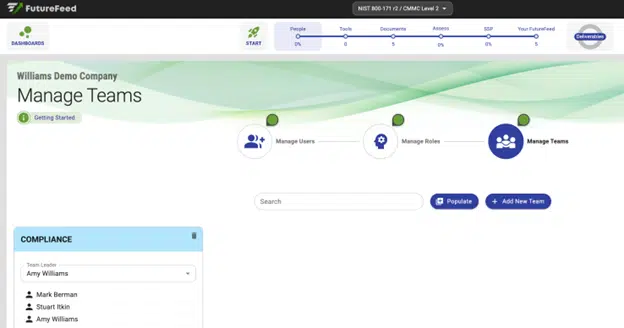
The next step is to assign control owners and document supporting tools. FutureFeed’s Controls and Assignments features provide excellent support here. Establish who will track updates, evidence, and ongoing compliance. Identify what parties in your organization are responsible, accountable, consulted and informed (RACI). The future fee, you can also provide temporary access to your subscription for third-party consultants, third-party partners, and even your assessors.
Example:
You assign IT Security to manage logging controls, HR to maintain personnel screening evidence, and configure automated reminders within FutureFeed to enforce accountability. You also set up a compliance team and designate a team leader.
Step 6 – Review Third-Party Vendor Requirements
Upload or reference vendor contracts and security attestations in the Vendors module to verify they meet CMMC-aligned requirements.
Example:
A cloud hosting provider is added as a vendor, and you record their FedRAMP Moderate equivalency to validate their suitability in the CUI environment and also confirm that their shared responsibility matrix is complete and that you understand your part of the responsibilities.
Step 7 – Assess Controls Against Your Boundary
Use the Control Assessment View to evaluate all 110 NIST 800-171 controls and 320 assessment objectives. Document objective-level compliance, upload evidence, and note gaps.
Example:
For control AC.3.1.1, your FutureFeed assessment indicates that appropriate authorized access control is applied.

Step 8 – Generate POAMs for Gaps
FutureFeed automatically generates Plans of Action and Milestones (POAMs) based on noncompliant objectives. You can assign owners, set deadlines, and track progress.
Example:
A POAM is created for each control examined and not yet met, assignments for completion are made for the appropriate team members and effective timelines for completion of POAMs are set.

Step 9 – Remediate Priority Gaps
FutureFeed’s remediation dashboard helps you focus on the quickest wins first to build momentum and increase compliance confidence.
Example:
You start by enabling screen lock policies and updating outdated procedures before moving to more complex technical changes.
Step 10 – Plan for Complex Remediation
For longer-term solutions—such as replacing non-compliant vendors or migrating systems—use FutureFeed’s task planning features to budget, track milestones, and coordinate across teams.
Example:
A multi-month plan is created in FutureFeed to transition from an unsupported file server to a compliant cloud service.
Ongoing – Monitor, Track, and Prepare for Assessment
FutureFeed provides dashboards, automated reminders, reporting, and evidence management to keep your compliance program active and audit-ready. Maintaining this discipline ensures a smoother journey toward your CMMC assessment.
Note:
Assessment scheduling is increasingly competitive due to limited Certified CMMC Assessors (CCAs). FutureFeed recommends planning your assessment timeline early to avoid delays.






Authors

