
The Road to Compliance
A twice-weekly path through compliance essentials. Every Tuesday and Thursday we publish a new article. Follow the road from the program decisions to the controls that prove them.



How a 40-Person Shop Can Cut Scope From 180 Assets to 22
The quote comes back, and the owner reads it twice to be sure the number is real. Every workstation, every server, every printer and phone in the building got swept into the assessment, and the price reflects all of it. That’s how a lot of CMMC projects begin: with a very bad afternoon. It doesn’t have to. The difference between that afternoon and a manageable project usually comes down to one decision nobody told the owner they get to make.
Available This TuesdayRead the article→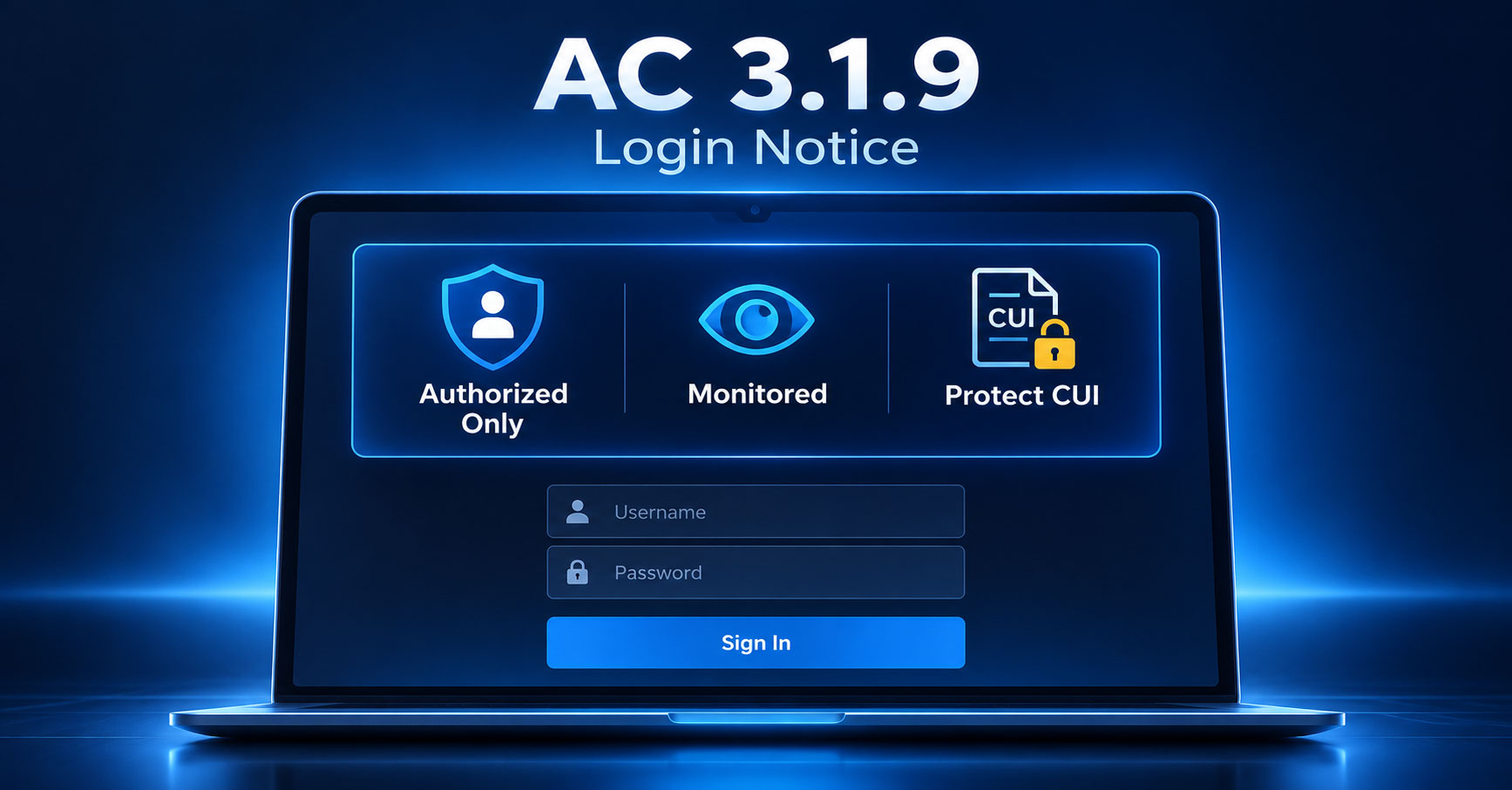

Access Control (AC) – 3.1.9
This control answers one question: before someone logs in, do they know the rules? It makes sure the answer is yes. You put a short notice, usually a banner on the login screen, that tells people what they’re stepping into: authorized users only, activity may be monitored, and CUI has to be handled properly. It’s a small control, but it’s the first thing a user sees, and it sets expectations before they touch anything…
Available This ThursdayRead the article→
The Boundary You Can Prove
There is a version of a boundary that looks finished. The VLANs are labeled, the out-of-scope list is filled in, the SSP says “no CUI” in all the right boxes. It’s a clean drawing, and it feels like progress. Then someone asks your network engineer three quiet questions, and the whole thing comes apart. The line you drew was never the point. Whether the line is real is the point.
Read the article→
Access Control (AC) – 3.1.8
This control answers one question: how many chances should an attacker get to guess a password? Not many, and never unlimited. Attackers guess passwords by trying thousands of combinations, fast. This control puts a stop to that. After a set number of failed attempts, the account locks, which turns an unlimited guessing game into a handful of chances before the door closes.
Read the article→
Shadow CUI: The Files Your Team Never Told You About
If you run IT, you already know the shadow files are out there. A drawing that got emailed home on a Friday night. A spec that landed in someone’s personal Dropbox so they could open it on the road. A laptop that got swapped out and never wiped. None of it was malicious. It was just people solving problems at nine at night with whatever was fastest. And you’re the one who has to go find it. Here’s the part most people miss: the tools matter far less than how you run the hunt.
Read the article→
Access Control (AC) – 3.1.7
This control does two jobs at once. First, a regular user simply can’t perform privileged functions: creating accounts, applying patches, running system integrity checks, managing encryption keys, or turning off your antivirus or intrusion detection. Those actions are walled off to authorized privileged users only. Second, whenever a privileged function does run, it’s recorded in your audit logs.
Read the article→
In Scope Isn’t One Thing
You followed the drawing. You know where controlled information enters, where it lands, who opens it, and where it goes after that. Now someone puts the list on the table and asks the obvious question: so is all of this in scope? It is the right question, and the honest answer surprises people. In scope is not one thing. It is a set of categories, each with a different amount of work attached, and sorting your list into them is the next real job.
Read the article→
Access Control (AC) – 3.1.6
Even the people who need admin rights shouldn’t use them all day. Most of an administrator’s day is ordinary work: reading email, browsing the web, writing documents. None of that needs admin power. This control says to do that everyday work from a normal account, and switch to the privileged account or role only when you’re actually doing admin or security work. If an admin clicks the wrong link while logged in as admin, the attacker instantly has admin control over your environment. On a regular account, it’s a much smaller problem. Separating the two shrinks the blast radius of a bad day.
Read the article→
Where CUI Actually Lives
Picture an engineering firm whose asset inventory lists forty-seven things, while the environment where controlled information actually moves is several times that size. The gap does not surface in an assessment. It comes out in a forty-five-minute conversation with three department heads, a few weeks before an assessment was scheduled. Three people. Forty-five minutes. That is all it takes to surface controlled information the documentation never mentioned. And if you own the boundary, this is your problem before it is anyone else’s…
Read the article→
Access Control (AC) – 3.1.5
If you’re responsible for CMMC compliance, this requirement comes down to four things. Give every user and process the least access the job needs, never higher. Keep admin and other privileged accounts to a small, named set of people. Treat security functions, like changing what’s logged or who can access what, as privileged, and limit who can touch them. And review privileged access regularly, keeping dated records. If you already have those things and can prove them, you’re well on your way…
Read the article→
When a Level 1 Contract Quietly Becomes a Level 2 Problem
Somewhere in most compliance folders is a short memo that says, in so many words, we handle FCI, not CUI, so we’re Level 1. It was probably right the day it was written. Someone did the work, made the call, and filed it. Here’s the question I’d ask, and it’s an uncomfortable one for a compliance lead: when did anyone last check whether it’s still true?
Read the article→
Access Control (AC) – 3.1.4
One person should never be able to quietly approve their own access, pay their own invoice, or hide their own actions. That’s exactly what separation of duties is designed to prevent, and it comes down to four things. Find the sensitive tasks where one person doing everything would be risky. Split those tasks so it takes more than one person: request versus approve, create versus review. Bring managers and process owners in to decide who does what, not just IT. And write down the split duties, then keep records showing they’re followed…
Read the article→
The Day Your Spreadsheet Stopped Telling the Truth
There’s a tab in a lot of CMMC spreadsheets called something like “Evidence, FINAL, v3, use this one.” It’s usually the tab nobody quite trusts. Somebody made it the source of truth months ago, the environment kept moving, and the tab didn’t. On a quiet Tuesday, that’s a mild annoyance. On the day an assessor sits down, or a big customer asks you to prove something, it’s a real problem. Almost every growing contractor hits a version of this. The spreadsheet that ran the whole compliance program beautifully at the start slowly stops being something you can rely on. The hardest part is that it never announces the change.
Read the article→
Access Control (AC) – 3.1.3
If you’re responsible for CMMC compliance, this requirement comes down to four things. Have the business decide where Controlled Unclassified Information (CUI) is allowed to move: between people, departments, systems, suppliers, and service providers. Have IT enforce those decisions with your network tools, so approved routes work and everything else is blocked. Stop CUI from leaving on unapproved routes, like personal email or consumer cloud storage. And keep dated records of the approved flows plus proof they’re enforced.
Read the article→
Finishing the Assessment Isn’t the Same as Posting It
A prime asks for your SPRS score. Not eventually. This quarter, in a questionnaire or a portal field, with a due date on it. It is a fair question, and it has a short answer. Either there is a current score posted under your CAGE code, or there is not. That question did not go away in July. The Department of War suspended the Phase 2 certification requirement and put the program under review, and I understand why some people read that as the pressure coming off. What changed is who verifies the work. Self-assessment did not pause, and neither did the expectation that you can show where you stand.
Read the article→
Access Control (AC) – 3.1.2
The last control decided who you trust to come in. This one decides how much you trust them once they’re inside. If the first control is the front door, this one is the set of interior doors: being allowed in the building doesn’t mean you can open every room. In plain terms, each person should be able to do only the tasks their job requires, and no more. Someone who enters invoices doesn’t need to change payroll settings or install software. This is the idea people call “least privilege”…
Read the article→
Your Real Deadline Is Your Prime’s, Not the Rule
Most of the business owners I talk to are watching the wrong calendar. They’re tracking the federal rule, waiting for the date a CMMC requirement officially lands in their contracts, and pacing themselves to that. It feels responsible. It’s also how a lot of good companies are about to get caught flat-footed. Because there’s a second deadline, and it’s the one that actually decides whether you keep your work. It didn’t come from the government. It came from your biggest customer, and it may already be sitting in your inbox.
Read the article→
Access Control (AC) – 3.1.1
Think of this control as deciding who you trust inside your environment. Every person, every automated process, and every device has to earn that trust before it’s allowed in. The lock on your front door is the familiar image, but the real point is simpler: every connection to your CUI environment should have a reason to be there. At any moment, you should be able to answer two questions about every person, process, and device in your environment…
Read the article→
Level 1 Looks Easy. That’s the Trap.
Level 1 is supposed to be the easy one. Fifteen controls instead of a hundred and ten, a self-assessment instead of an outside auditor. So here’s the question I keep coming back to: if it’s so easy, why do good companies still get into trouble with it? Because they do. Every so often I hear about another capable, well-run contractor that did what it was told, self-assessed, filed the affirmation, felt good about it, and still ended up somewhere it never expected. Fifteen controls. How does that go wrong?
Read the article→
Security Assessment (CA) – 3.12.1 to 3.12.4
This family is the engine that keeps you compliant after the setup work is done. It’s a loop with four moving parts: assess whether your controls are really working and not just written down; write every gap into a Plan of Action & Milestones (POA&M) with an owner and a due date, then work it; monitor your controls all year so you catch drift before your next assessment does; and keep your System Security Plan (SSP) current as the master record of how you meet each requirement. Run the loop and your program stays honest. Skip it and everything you built quietly falls out of date.
Read the article→
Does CMMC Even Apply to Me? FCI, CUI, and the Level Question
One of the first questions I ask a company is simple: what CMMC level are you pursuing? The answer I hear surprisingly often is, “We think Level 1.” Then I ask why. That’s usually where the room gets quiet. It isn’t because they’re unprepared. Usually they’re good at what they do and they’ve already invested time and money. The quiet comes because nobody has actually answered the question. They assumed Level 1, built toward it, and never went back to check whether the assumption was true.
Read the article→
Risk Assessment (RA) – 3.11.1, 3.11.2, 3.11.3
This family is about knowing what could hurt you and doing something about it, before someone else finds the weak spot first. Three requirements: understand what could hurt your organization and how likely it is, on a regular schedule; scan your systems for weaknesses as new ones show up; and fix what you find, worst first. Keep dated records of all three and you’re well on your way.
Read the article→
What CMMC Actually Costs: Implementation, Operations, and Verification
Implementation builds security. Assessment verifies it. They solve different problems and carry very different price tags, and the cost conversation keeps collapsing them into a single number. Pull the total apart and you find five separate buckets: required protection, architecture and technology choices, internal labor, verification, and avoidable spending. Only one of those is the assessment fee, and most of the rest is yours to control.
Read the article→
Personnel Security (PS) – 3.9.1, 3.9.2
This family is about the two moments that matter most with any employee or contractor: the day they arrive and the day they leave. Before someone gets access to systems that process CUI, make sure they’ve been screened for the role. And when they walk out the door, make sure your systems and information don’t walk out with them: accounts disabled, laptops and badges collected, with dated records to prove it.
Read the article→
Why Security Is a Business Decision
Security gets filed under IT until the day it decides whether you can bid. The contracts you win, the customers who keep you on their supplier list, the liability you carry when something goes wrong: all of it now runs through whether you can prove your security posture. That makes this a decision for the people who own the business outcome, not one to delegate down the org chart.
Read the article→
Awareness & Training (AT) – 3.2.1, 3.2.2, 3.2.3
If you’ve opened NIST SP 800-171, you probably noticed Access Control (3.1) comes before Awareness and Training (3.2). So why start here? Because the control numbers tell you where to find a requirement, not where to begin building your program. I’ve found it’s easier to build the people side first, then layer the technical controls on top.
Read the article→Never miss a stop on the road
New articles every Tuesday and Thursday. Get The Road to Compliance delivered to your inbox so the essentials come to you.

